Learn why a single API requires different release technologies. Explore how pellet technology enables Immediate, Sustained, Delayed, and Enteric-Coated profiles.
Written By
Aishwarya Salunkhe
Published on
03 September 2026
Tags
Drug release is vital because it dictates how the active ingredient becomes available to act. The manner and timing of drug release determine onset speed and the consistency of the effect. Therefore, simply delivering the API is not enough; the formulation must ensure release at the right time and place in the gastrointestinal tract.
Each API has its own properties and drug delivery needs. Some APIs may need to be delivered quickly to ensure the drug reaches the body fast enough, whereas others may need slow release over time. Some APIs require delayed release and protection from the stomach's acidic environment.
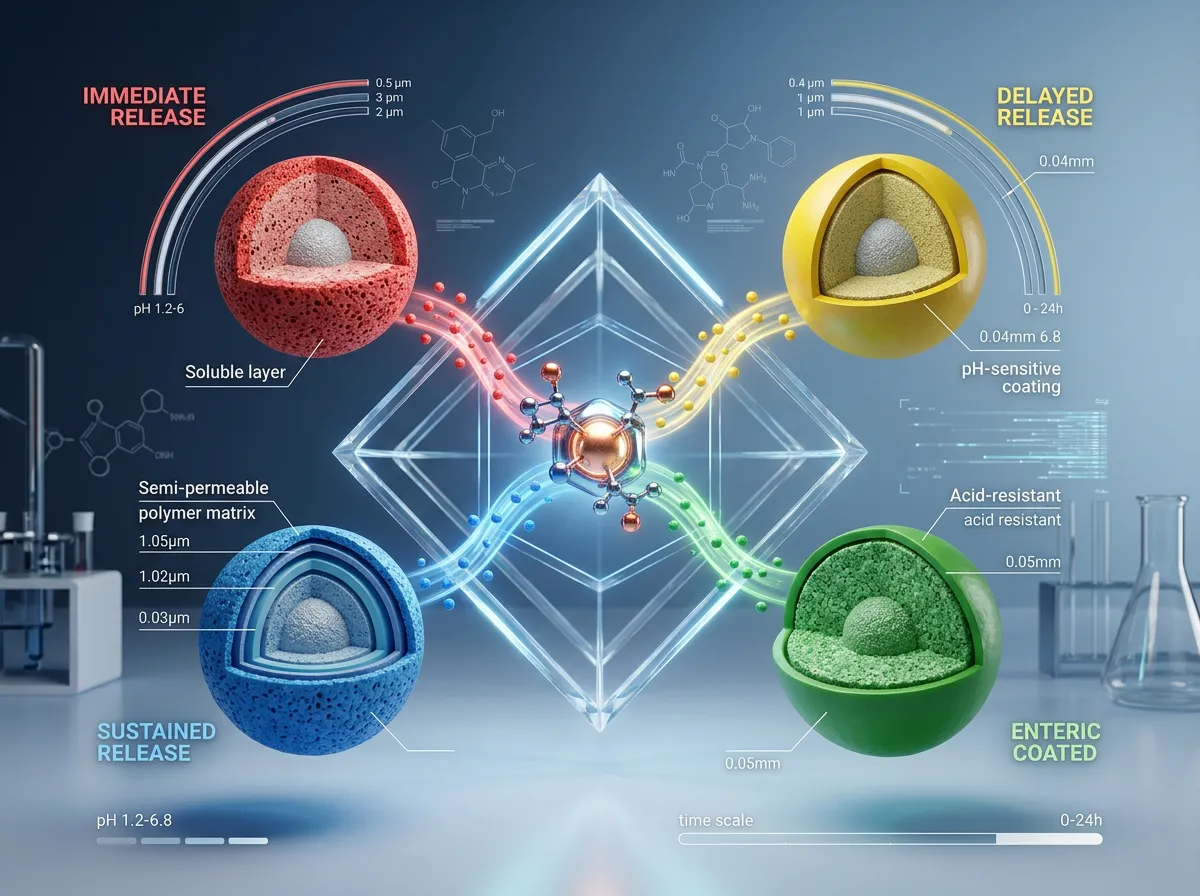
This is why different methods of drug delivery exist, like Immediate Release (IR), Sustained Release (SR), Delayed Release (DR), and Enteric Coated (EC). The same API could use several drug delivery techniques depending on stability, solubility, pharmacokinetics, and the purpose of drug administration.
It is especially significant in the context of using pellets as carriers for drugs, as both the formulation and coating techniques may be adapted to attain a required release pattern.
The correct drug release profile depends on certain aspects of the API and the result to be achieved through its use. The drug should be available as needed, stable, and transported to the proper absorption site.
API stability under exposure to moisture, heat, light, oxygen, and gastric conditions can affect the selection of the appropriate release system. Some sensitive APIs may require protective coatings or delayed release.
An API's solubility and dissolution influence its rate of availability for absorption. Formulators can manipulate the dissolution process to get the desired dissolution and availability of the drug.
The API half-life is a factor to consider when deciding the frequency of administration. The shorter the API half-life, the better it would do with a sustained-release system, where suitable.
Dosage form selection can also be based on dose frequency and patient convenience. An appropriately developed modified-release delivery system can reduce dosing frequency and provide a stable drug-delivery profile.
The appropriate release mechanism is ultimately determined through balancing the various attributes rather than basing it on a particular characteristic.
The preferred target location for drug release can determine the kind of coating needed. For instance, enteric coating resists the gastric environment and releases in the intestinal environment.
The site and speed of API absorption can determine how the drug delivery system is formulated. If the API is absorbed at a specific site in the digestive tract, the delivery system must deliver it there.
Some APIs are unstable in the stomach's acidic environment. You can formulate such APIs with a protective coating, such as an enteric coating or delayed-release formulation, to protect the API until it reaches its release site.
An API can be either an IR or SR version, depending on the rate and duration at which the drug must be released. The pellet formulation allows you to alter the release profile by changing the formula and coatings.
Immediate-release dosage forms are designed to make the drug available quickly. This is ideal when rapid availability of the drug is needed, and there is no requirement for delayed or extended drug release.
In IR pellets, the dosage form and coating allow the drug to dissolve and become available for absorption without a barrier to release.
The aim of a sustained-release formulation is to release the API gradually over a prolonged period rather than making it fully available in a single dose. This can be advantageous for some APIs that require extended drug availability and may reduce dosing frequency.
In SR pellets, functional coating or other release-control methods could control the rate of API release. These factors can be adjusted to achieve the desired release profile.
A pellet formulation can then be developed using the same API, depending on the design and coating methodology applied. An IR formulation can provide rapid drug release, whereas an SR formulation can provide controlled release.
Pellet technology is especially helpful when manufacturers need to develop different dosage forms or release methods using the same API.
While DR and EC forms may serve to delay the release of the drug, they are not exactly the same thing. The distinction lies in when and why the release should be delayed.
Delayed-release delivery systems aim to delay the release of the active pharmaceutical ingredient immediately after intake. In this case, the release is intended to be delayed until certain conditions are met. These delivery methods can be effective when the API should be released later than immediately after ingestion.
Pellets may also provide delayed release using various coating or formulation methods.
Enteric-coated systems are a special type of delayed-release system designed to protect the active ingredient from the harsh environment of the stomach and release the drug in the intestine. An enteric coating is stable under stomach conditions and will dissolve in a suitable environment in the intestines.
This type of technology can be used with acid-labile APIs such as Omeprazole, Rabeprazole, Lansoprazole, and Pancreatin.
The key difference is that delayed release refers to the desired method of drug release, whereas enteric coating is a formulation method that achieves delayed release based on gastrointestinal pH.
Thus, while enteric-coated microcapsules can be considered delayed-release drugs, other delayed-release formulations do not use enteric coating.
One of the primary strengths of using pellets in pharmaceuticals is their adaptability. Formulators can create different pellets of the same active substance by changing the formulation, pellet shape, and coating system. These pellets can be IR, SR, DR, and EC pellets, among others, depending on the desired drug-delivery method.
The drug in the drug-coated pellets is applied on the starter cores so that drug uniformity is ensured. This varies depending on the amount of drug to be coated and the composition of the coating system needed for the formulation.
The coating function greatly influences drug release. Based on the intended purpose, pellets may be coated to promote rapid release, controlled release, delayed release, or protect the API in the stomach environment.
Functional coating is another important process in controlled drug release. Pellets can be coated to facilitate instant release, gradual release of the active ingredient, delayed release, or protection of the active ingredient from the stomach environment.
Coating thickness may affect the rate of active-ingredient release. The more resistant the coating, the better control there will be over medication release, but a suitable coating may also ensure rapid release.
Pellet size may also affect coating characteristics, drug loading, flow, and dissolution. A controlled size distribution is essential for successful coating.
Pharmaceutical companies can formulate pellets with various release profiles by incorporating factors such as drug layering, polymer choice, coating composition, coating thickness, and pellet size. Thus, pellet technology is a versatile drug delivery system that allows the same API to be adapted to various formulations.
For instance, a drug that needs quick availability can be formulated as IR pellets, whereas the same drug can be formulated as SR or EC pellets if slow release or gastric resistance is required, respectively.
The choice of drug delivery technology does not only depend on the API involved. Instead, the formulation must be tailored to the API's properties and the intended purpose of the drug delivery system. For this reason, the same API can be formulated using various technologies such as IR, SR, DR, or EC.
If the API is sensitive to moisture, light, or heat, the drug delivery system may need an additional protective layer to protect the formulation.
The solubility and dissolution behavior of the active ingredient play an important role in its availability for absorption. The release system can be adjusted to provide the right dissolution profile.
A shorter API half-life is useful for designing a sustained-release preparation when a prolonged effect is needed, whereas other APIs are better suited to immediate-release formulations.
Unstable APIs in acidic environments may require an enteric coating when formulated into pellets to protect them from degradation in the stomach and release them in the intestines.
The required duration of drug efficacy may determine whether immediate, extended, or delayed release is best suited.
The location in the GI tract where API release is needed is also important. Some formulations may require fast drug release, whereas others may require delayed release after reaching the intestine.
The intended therapeutic use, dosing requirements, and desired drug-delivery profiles ultimately influence the selection of the release technology.
No single drug-delivery technology fits every active pharmaceutical ingredient (API). It depends on the API properties, the treatment goal, the target site, and how long the drug must remain available. Pellet technology offers the flexibility to change the formulation and coating properties to achieve the desired profile.
Aishwarya Salunkhe
14 July 2026
Discover why multiparticulate drug delivery systems are gaining popularity, offering better drug distribution, controlled release, stability, and formulation flexibility.
Read More →
Aishwarya Salunkhe
09 September 2026
Discover how multiparticulate drug delivery systems use engineered pellets and MUPS to achieve sustained, delayed, enteric, and customized drug-release profiles.
Read More →
Aishwarya Salunkhe
03 September 2026
Learn why a single API requires different release technologies. Explore how pellet technology enables Immediate, Sustained, Delayed, and Enteric-Coated profiles.
Read More →
Aishwarya Salunkhe
02 February 2026
Understanding the advantages of floating drug delivery systems (FDDS) in nutraceuticals. Learn how these systems optimize absorption, release, and efficacy
Read More →

Aishwarya Salunkhe
02 February 2026
Explore how enteric-coated pellets protect active ingredients from gastric acid, resulting in optimum release and bioavailability in pharmaceutical formulations
Read More →
Aishwarya Salunkhe
03 September 2026
Learn why a single API requires different release technologies. Explore how pellet technology enables Immediate, Sustained, Delayed, and Enteric-Coated profiles.
Read More →

INDIA - CORPORATE OFFICE
Unit No. 1, 2nd Floor, Vicino (Mega Mall), New Link Rd, Oshiwara, Andheri West, Mumbai, Maharashtra, India. 400102
MANUFACTURING FACILITY
Unit No. 1, Survey No. 52/2, NH8, Shirsad, Vajreshwari Road, Opp. Mandvi Police Station, Village - Mandvi, Taluka- Vasai, District- Palghar 401 303, India.